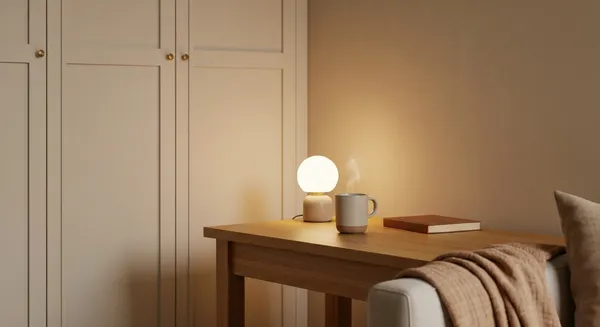
The "Closing Shift" Routine: How to Put a Small Apartment to Sleep for Mental Relief
Discover how a 15-minute small apartment closing shift routine creates psychological boundaries, cuts visual noise, and resets your studio space for sleep.
Article Information & Navigation
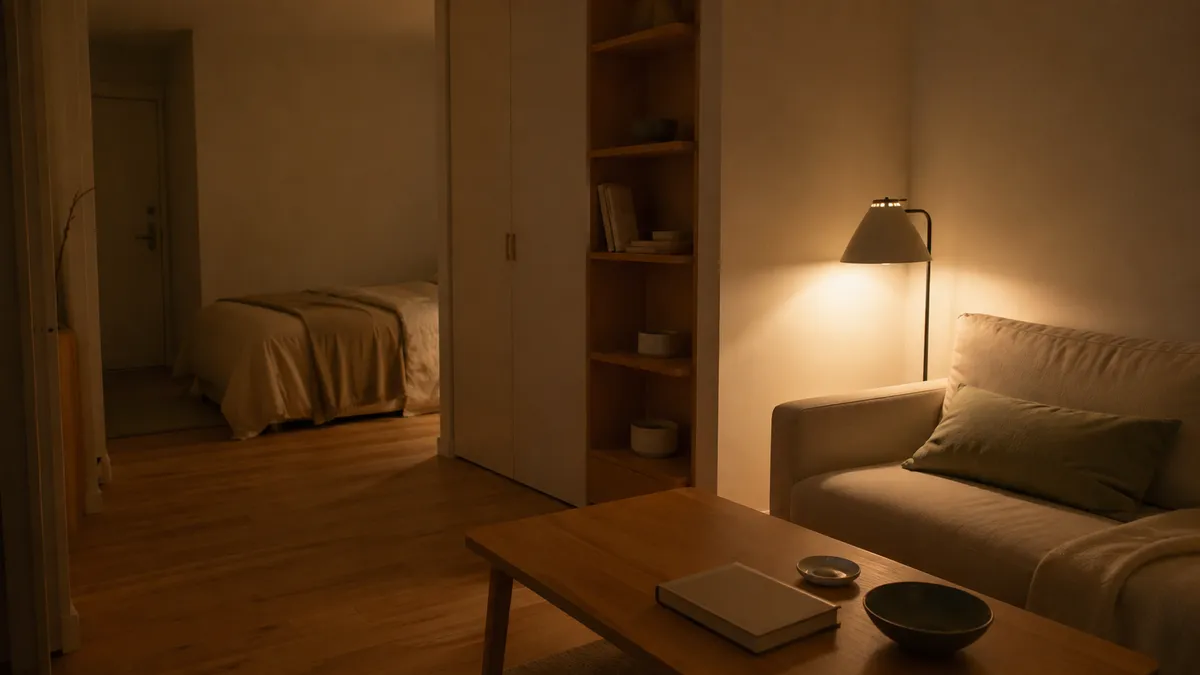
If you live in an open-plan layout or a studio, the end of the day rarely feels like a true conclusion. When a work laptop rests on the only table you have and the kitchen counter is perfectly visible from your pillows, the physical boundaries between working, eating, and resting simply do not exist. In these environments, figuring out how to put a studio apartment to sleep is less about chores and more about creating a psychological buffer.
This is the exact purpose of a small apartment closing shift.
Borrowing a concept from the hospitality and retail industries—where a space is methodically “reset” for the next morning—this approach has been widely adapted as a practical home wellness habit. For renters in tight floor plans, a tiny apartment reset routine is not a deep cleaning session. Instead, it is a deliberate act of emotional boundary-setting. Adapting the workplace productivity concept of a psychological shutdown ritual to your living space provides the mind with a clear, sensory signal that the high-alert functioning of the day is strictly over, allowing the nervous system to finally transition into nighttime recovery.
The Psychology of “Boundary Ambiguity” for Renters

If you have ever wondered why your studio apartment feels exhausting at night, the answer is rarely just physical tiredness. In environmental psychology, there is a concept known as “boundary ambiguity”. This occurs when a single physical environment is forced to serve multiple, often conflicting, functions without clear physical or psychological demarcations.
In a traditional home, structural walls naturally compartmentalize activities. You leave the home office and enter the living room, physically leaving work behind. However, in open-plan layouts, the lack of these walls forces the brain to process the demands of work, chores, and rest simultaneously. According to the Spatial Harmony principles developed by Dr. Sally Augustin and Valerie Jardon, psychological stress directly results from a lack of alignment between space design and human activity. Without a sensory signal that separates the “doing” from the “resting,” the environment lacks the necessary cues to reduce friction and allow the nervous system to power down.
Why Your Studio Apartment Keeps Your Brain on “High Alert”
When you are trying to relax on the sofa but can clearly see the unpaid bills on the counter and the laptop on the dining table, your brain cannot fully disengage. It experiences what environmental psychologists call “directed attention fatigue”.
This inability to look away from uncompleted tasks triggers the Zeigarnik Effect, a psychological phenomenon indicating that the human mind tends to fixate on interrupted or unfinished tasks far more than completed ones. Seeing these visual triggers keeps the brain’s neural inhibitory system chronically engaged. It is constantly reminding you of what still needs to be done.
Creating a mental boundary in small spaces is not about building temporary walls; it is about establishing “visual silence”. When the space lacks this visual silence, the brain remains on a high-alert setting, treating the entire apartment as an active workspace rather than a place of refuge. This is why developing clever boundary ideas for a studio apartment often relies more on sensory shifts—like lighting and concealing clutter—than on buying room dividers.
What is an Apartment “Closing Shift”? (Hint: It’s Not Deep Cleaning)
When looking into establishing a closing shift routine for the home, it is essential to clarify what the process actually entails. A functional closing shift is generally a 10-to-15-minute sensory reset, not an exhaustive deep cleaning session. It is the practical approach of removing immediate visual triggers and altering the atmospheric condition of the room so that the entire space feels officially “off duty.”
Sensory Relief vs. The Hyper-Organization Trap

Many renters fall into the habit of trying to achieve perfect cleanliness before getting into bed. However, attempting to micro-manage every single item at the end of a long day frequently leads to organization burnout. Evaluating, sorting, and categorizing every misplaced object demands active inventory maintenance, which rapidly depletes whatever willpower remains.
In behavioral science, this psychological drain is recognized as decision fatigue. At the end of the day, the brain craves cognitive ease. When a nightly routine requires too many micro-decisions, the mental friction becomes too high to maintain consistently.
If trying to keep every drawer perfectly categorized leaves you exhausted, you might be dealing with toxic organization. The "Hyper-Organization" Trap: Why Over-Organizing Makes Small Spaces Feel Worse Discover why macro-sorting is often a far more sustainable approach for small-space renters.
This is precisely why a sensory reset strategy for small spaces focuses solely on hiding the most disruptive visual stimuli rather than organizing perfectly. When evaluating a closing shift vs. deep cleaning for an apartment, the fundamental difference is intent. The closing shift relies on macro-sorting—quickly grouping items to create visual calm—rather than the meticulous micro-organizing that often crowds the visual volume of a room with endless sorting tools and acrylic bins.
The 15-Minute “Snug and Still” Closing Shift (Step-by-Step)
Designing an effective evening routine for small apartments relies heavily on the path of least resistance. A low-friction approach focuses entirely on immediate sensory shifts—sight, light, and spatial awareness—rather than labor-intensive scrubbing. This 15-minute apartment reset is structured specifically around the limitations and psychological needs of tight floor plans.
Step 1: The “Visual Silence” Sweep (Hiding the Day’s Reminders)
The first five minutes of the process target flat surfaces, often referred to as “hotspots.” The primary objective is to drastically drop the visual noise level by stowing away laptops, mail, and micro-trash. Removing work-related items from the immediate line of sight reduces the cognitive load required to process the room.
Want to understand exactly why leaving a laptop on your dining table drains your energy? The 'Visual Silence' Rule: Why Your Tiny Apartment Feels Mentally Exhausting Discover the underlying psychology of visual noise and how our eyes process small-space clutter.
For renters dealing with limited storage, utilizing the “Holding Basket” method offers a practical solution. A designated, opaque basket provides the eyes with a clear place to rest, containing visual clutter without requiring the cognitive effort of a full, permanent cleanup. Combining this with the “One-Touch” rule—where an item is moved directly to its holding place rather than shuffled around the counter—keeps this step brief and highly efficient.
Step 2: The Lighting Transition (From Task to Ambient)
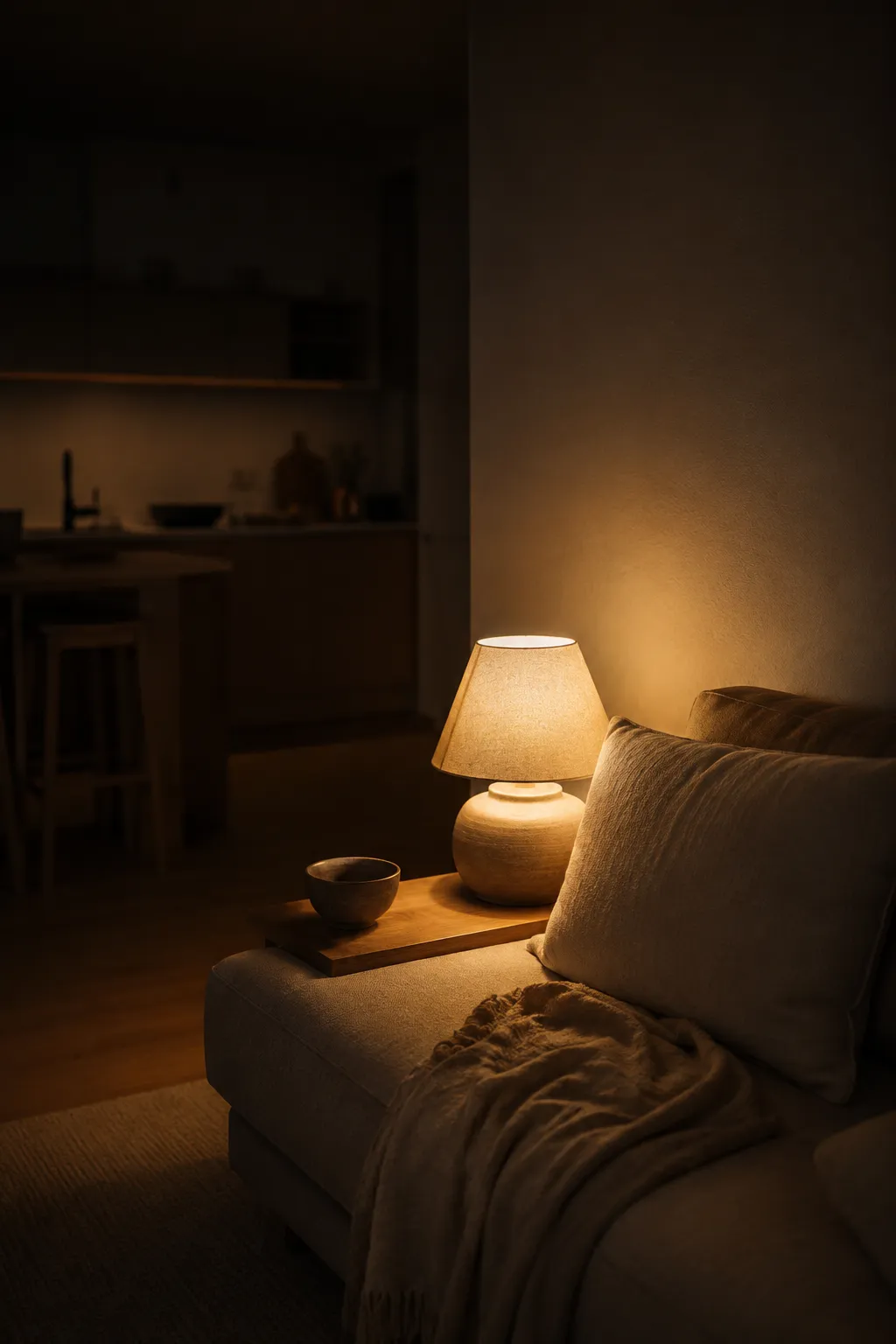
Lighting plays a crucial role in spatial perception. Bright, overhead lighting often mimics a corporate office environment, which can keep cortisol levels artificially high. The lighting transition acts as a physical boundary in spaces where structural walls do not exist.
Switching off overhead fixtures and turning on low-level point lighting—such as table or floor lamps utilizing warm 2700K bulbs—instantly changes the atmosphere. This technique is deeply rooted in the Hygge principles outlined by Meik Wiking, which emphasize the critical role of warm, low lighting in winding down the human nervous system. In a studio apartment, this shadowed lighting effect strategically shrinks the perceived world to just the illuminated rest area, effectively hiding a messy kitchen sink or a cluttered workspace in the darkness.
Step 3: Activating the “Calm Corner”
The final stage of a low-friction evening routine for studio renters does not end with cleaning; it concludes by physically relocating to an emotional micro-zone. This designated “Calm Corner” must be entirely free of functional demands, meaning no folded laundry, no laptops, and no work documents.
Need help establishing your emotional micro-zone? The "Calm Corners" Method: How to Make a Studio Apartment Feel Emotionally Bigger Learn exactly how to apply the 30% Negative Space Rule to create a visual retreat, even in a 300-square-foot footprint.
Maintaining a strict negative space rule in this specific seating area ensures it remains visually quiet. Sitting in this dedicated zone interrupts the continuous loop of cognitive processing that occurs when pacing around a multi-functional room. It acts as the final sensory cue, signaling to the nervous system that the active “shift” is over and the environment is finally safe for rest.
Sustaining the Habit: A Low-Friction Approach for Exhausted Renters
Consistency in any home environment requires designing out physical resistance. When a renter is completely physically or mentally depleted, the closing shift must adapt to their specific “clutter threshold”—the exact volume of items they can manage or tolerate without experiencing elevated anxiety.
If keeping up with daily resets feels impossible, the layout itself might be causing too much resistance. The "Low-Friction" Apartment: 7 Innocent Habits That Create Mental Noise in Small Spaces Explore how to evaluate your clutter threshold and arrange your tiny space for minimum daily effort.
Building sustainable apartment habits relies on understanding that the routine must flex based on daily energy levels. Low-friction living is not about pushing through exhaustion; it is about creating a system that works even on the hardest days.
The “Bare Minimum” Closing Shift

On days of total depletion, the standard 15-minute reset might feel insurmountable. This is where understanding how to maintain an evening routine when exhausted becomes critical. When energy is low, human behavior relies entirely on convenience.
According to the “20-Second Rule” outlined by Shawn Achor, if a habit takes more than 20 seconds of extra physical or mental friction to initiate, the default human response is to abandon the task entirely. This aligns with the behavioral principles found in James Clear’s Atomic Habits, which state that human behavior naturally gravitates toward the path of least effort.
Therefore, the “Bare Minimum” closing shift involves dropping all organizational expectations and committing to only one highly impactful action: changing the lighting. Simply turning off the active overhead lights and turning on a single warm lamp takes less than five seconds. It bypasses the 20-second friction barrier entirely, requiring almost zero physical effort, yet it still provides the brain with the crucial sensory cue that the day has officially ended.
Ultimately, living in a small apartment requires acknowledging that physical boundaries are inherently limited. Implementing a closing shift routine is a practical, research-backed method to establish those boundaries psychologically. The goal is never to achieve flawless minimalism or an immaculate living space at the end of every single day. Instead, it is about purposefully providing the mind with the sensory relief it needs to successfully transition from the high-alert demands of the day to the necessary restfulness of the night.
Sources & References
- Shutdown Ritual: A Practice for Productivity and Psychological Detachment — Saul McLeod, PhD | Simply Psychology
- The Harmonic Principles: Spatial Harmony — Dr. Sally Augustin & Valerie Jardon | IA Interior Architects
- Zeigarnik Effect — American Psychological Association (APA Dictionary of Psychology)
- Decision Fatigue: Why Do We Make Worse Decisions at the End of the Day? — Dr. Lauren Braithwaite | The Decision Lab
- The Little Book of Hygge: Danish Secrets to Happy Living — Meik Wiking | HarperCollins
- The Happiness Advantage: How a Positive Brain Fuels Success in Work and Life — Shawn Achor | Crown Currency / Penguin Random House