The "Visual Silence" Rule: Why Your Tiny Apartment Feels Mentally Exhausting (And The 15-Minute Calm Reset)
Discover the visual silence rule to understand why your tiny apartment feels overwhelming and learn a simple 15-minute calm reset routine.
Article Information & Navigation
You unlock the door, drop your keys, and step into your apartment after a long day. The floors are swept, the dishes are done, and technically, the room is clean. Yet, as you sit on the sofa, you don’t feel that immediate wave of relief you’ve been craving. Instead, you feel a subtle, persistent mental tightness.
If this sounds familiar, you are not failing at tidiness, and your apartment isn’t necessarily too small. When observing patterns across small-space living experiences, a common question arises: why does a tiny apartment feel overwhelming even when everything is put away?
The answer often lies in how our eyes process the environment. Even when an apartment is highly organized, a flood of exposed textures, mismatched labels, and open shelves can keep the brain in a state of low-level, constant alertness. Through analyzing environmental psychology and everyday habits, a clear pattern emerges: the space is simply lacking the visual silence rule.
Understanding how this environment affects your daily energy shifts the goal from simply “organizing clutter” to actively protecting your peace of mind. Let’s explore what makes a mentally exhausting apartment, and how a simple, observation-based reset routine can help quiet the noise.
The Hidden Culprit: Why Your Small Space Drains Your Energy
It is a recurring observation among small-space renters: stepping inside doesn’t always bring immediate relief. This isn’t a personal failure or a lack of minimalist discipline; it is a well-documented response to sensory overload in small spaces.
When analyzing the psychological impact of living in a tiny apartment, environmental psychologists point to how our brains constantly filter background data. According to foundational research on Attention Restoration Theory published by Dr. Stephen Kaplan, the human mind expends significant cognitive energy actively blocking out surrounding visual distractions just to maintain focus. In a cramped environment, this constant effort to filter out nearby background stimuli quickly leads to directed attention fatigue.
In a standard-sized home, you can simply walk into an empty room to rest your eyes. However, drawing from neuroscientific research on how visual stimuli compete for neural representation and strain our mental processing, a studio or cramped apartment often fails to provide this essential visual “escape room” for our eyes.
When your bed, workspace, and kitchen counters are all constantly within your peripheral vision, the mind cannot fully drop its guard. It continues to track uncompleted tasks and process contrasting objects, leading to what design discussions frequently term apartment fatigue. The exhaustion is real, but it is driven by the unrelenting volume of visual data, not a lack of square footage.
Visual Clutter vs. Physical Clutter: Understanding “Visual Noise”
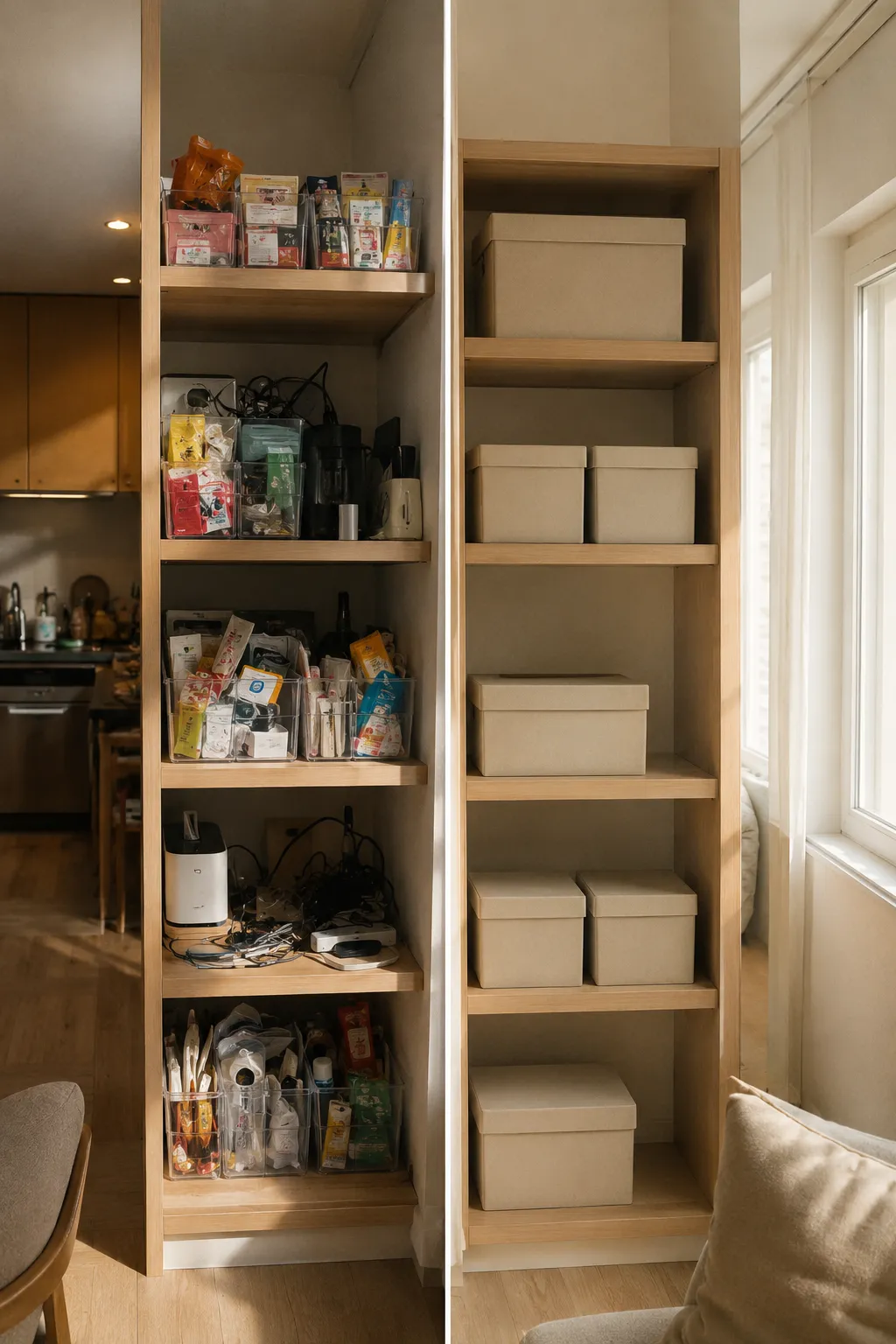
Understanding why certain spaces remain stressful despite being clean often comes down to the clear difference between visual clutter and physical clutter. This distinction helps explain a frustrating question many renters face: what makes a room look cluttered even when clean?
Physical clutter involves objects left out of place—shoes by the door, unwashed dishes, or mail on the table. Visual clutter, however, describes an environment that feels chaotic to the eye even when everything is perfectly put away.
This hidden friction creates what design research calls visual noise in home environments. In compact layouts, this constant background data can be just as exhausting as physical mess, keeping your mind subtly tethered to household chores.
The Psychology of “Loud” Objects
Every object we bring into our homes carries what design author Frida Ramstedt defines as “visual weight.” In her work The Interior Design Handbook, she explains that certain elements demand far more visual effort than others. High-contrast color schemes, bold patterns, and intersecting lines force the eyes to move continuously across a room without catching a rest.
A major, often overlooked source of this constant eye movement is what Marie Kondo identifies as the underlying “visual noise” of corporate packaging. In her foundational work The Life-Changing Magic of Tidying Up, Kondo points out that product wrappers are specifically engineered to scream for your attention on crowded retail shelves. Bold logos and neon typography don’t stop shouting just because they are now sitting on your bathroom ledge or kitchen counter.
Even when neatly arranged, these exposed labels constantly register in your subconscious mind. They whisper micro-reminders of things to do, products to buy, and tasks to complete, preventing your small space from functioning as a true sensory sanctuary.
Why Standard “Organizing” Fails in Studio Apartments
When a small room feels chaotic, the most common instinct is to buy standard home organization supplies. However, conventional storage solutions frequently backfire when applied to tight, open layouts.
A prime example is the widespread reliance on open shelving and clear plastic storage bins. While clear containers work beautifully inside deep, dark pantries where you need to spot items quickly, leaving them fully exposed in a studio apartment creates an accidental mosaic effect.
Drawing from the minimalist organizing principles and methodology shared by expert Shira Gill in her book, Minimalista, clear containers out in the open don’t hide anything; they simply showcase a fragmented mix of shapes, labels, and colors. In an open layout, this builds a heavy visual weight that keeps the room looking busy, regardless of how neatly those items are stacked.
This approach falls into what organization experts call the “acrylic trap”. When everything remains visible, nothing is truly at rest. By placing mismatched daily necessities on open shelves, standard organizing accidentally turns functional objects into permanent visual noise.
If you realize that standard transparent organizers are secretly transforming your home into a busy retail display instead of a sanctuary, you are likely falling into common layout errors. Visual Clutter Traps: 7 Storage Mistakes Making Your Tiny Apartment Feel Cramped (And Aesthetic Fixes) Deep dive into our full tactical guide to discover how switching to opaque, textured alternatives can instantly restore spatial scale and mental calm.
What is the “Visual Silence” Rule? (The Warm Minimalism Approach)
Homes that feel naturally restorative rarely require throwing away your functional belongings. Figuring out how to make a small room feel calm and relaxing is about changing how those remaining items interact with your daily visual field. This gentle shift in perspective forms the core of the visual silence rule.
Unlike rigid aesthetic trends that demand you live with almost nothing, warm minimalism decor focuses on creating intentional softness. It acknowledges your daily habits but organizes them to reduce mental friction. To achieve these calm apartment aesthetics, design research consistently highlights three low-effort strategies that work beautifully in rental spaces.
1. The “Decanting” Strategy for Instant Calm
One of the most effective ways to lower the visual volume in a room is to address the everyday items sitting on your counters. Our eyes are highly sensitive to sudden, sharp shifts in color and text.
When a bathroom ledge holds multiple bottles of soap and shampoo, each with its own bright, commercial branding, it creates a competitive visual environment. Decanting is the practice of moving liquids from their original packaging into uniform, neutral containers.
According to the aesthetic organization principles detailed by authors Julie Carlson and Margot Guralnick in their book, Remodelista: The Organized Home, this shift acts as a defensive strategy against visual clutter. Using opaque ceramic or muted glass dispensers in warm beige or clay tones immediately unifies a surface, replacing corporate typography with silent, calming forms.
2. Creating “Negative Space” Zones
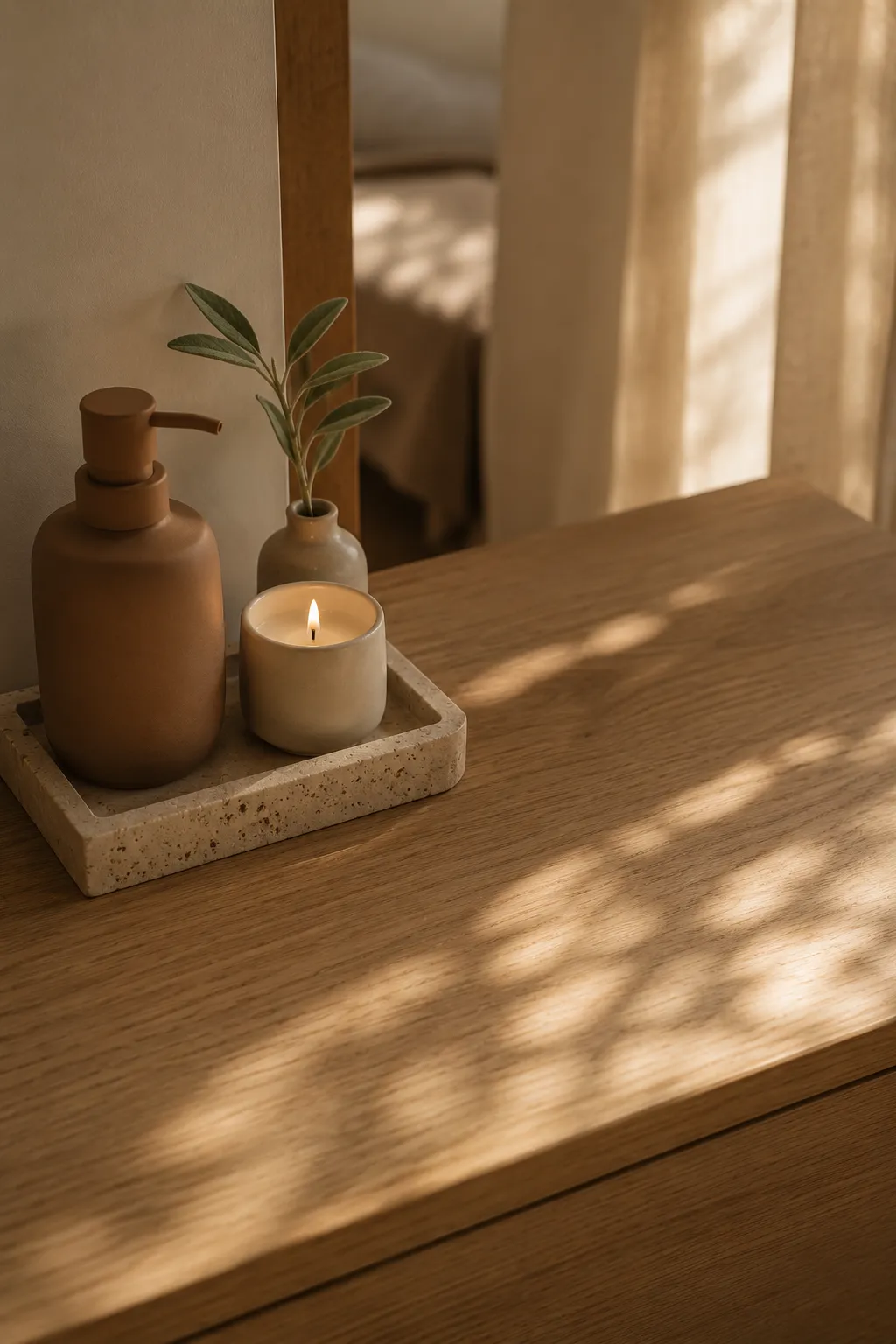
In a compact apartment, there is a natural temptation to utilize every single square inch of flat space for storage or decor. However, when every surface is completely occupied, the eye has nowhere to rest.
This observation draws heavily from the traditional Japanese design concept of Ma (間), which translates roughly to the intentional placement of “pure emptiness” between objects. Often explored in slow-living design anthologies like Nathan Williams’s The Kinfolk Home, creating negative space involves leaving at least 30% of any prominent flat surface entirely empty.
When you intentionally preserve an empty zone on a coffee table or a dresser, you provide a much-needed visual pause. Where the eye can find a moment of rest, the mind naturally follows.
While maintaining empty surfaces creates a necessary visual pause, translating this philosophy into a tight layout requires a dedicated structural strategy. The "Calm Corners" Method: How to Make a Studio Apartment Feel Emotionally Bigger Discover our complete blueprint for emotional zoning to design a protected psychological sanctuary without blocking natural light or erecting bulky physical dividers.
3. Softening High-Contrast Areas
Another overlooked source of sensory drain is the presence of harsh, dark voids set against light backdrops. In many rentals, a large black television screen or outdated, dark-toned flooring can act as a heavy visual anchor.
According to the visual weight and interior composition principles detailed in Frida Ramstedt’s The Interior Design Handbook, massive, high-contrast dark elements draw an unbalanced amount of attention in tight quarters. This sharp contrast can inadvertently make the walls feel like they are closing in.
To soften these areas, styling approaches inspired by modern Japandi aesthetics suggest using muted textiles to bridge the visual gap. Draping a light linen throw over a dark sofa, or using a large neutral rug to mask harsh flooring, helps these elements blend seamlessly.
The 15-Minute Calm Reset: Instantly Reduce Visual Overload
When an apartment feels overwhelming, the thought of a deep, hours-long organizing session can actually increase stress. Observing how successful small-space residents manage their environments reveals a different approach: frequent, low-effort resets.
This 15-minute calm reset serves as a highly effective routine for your tiny apartment. Rather than aiming for perfect organization, the goal is simply to mute the loudest visual triggers. If you need a quick way to declutter your visual space, breaking the process into three sensory-focused stages often works best.
| Timeframe | Area of Focus | Goal | Inspiration / Source |
|---|---|---|---|
| Minutes 1–5 | Main Flat Surfaces | Drop immediate visual noise | The "Holding Basket" Method |
| Minutes 5–10 | Technical Elements | Eliminate micro-anxieties | RMCAD (Environmental Psychology) |
| Minutes 10–15 | Lighting & Scent | Lower cortisol levels | The Happiness Research Institute |
Minute 1-5: The “Flat Surface” Sweep
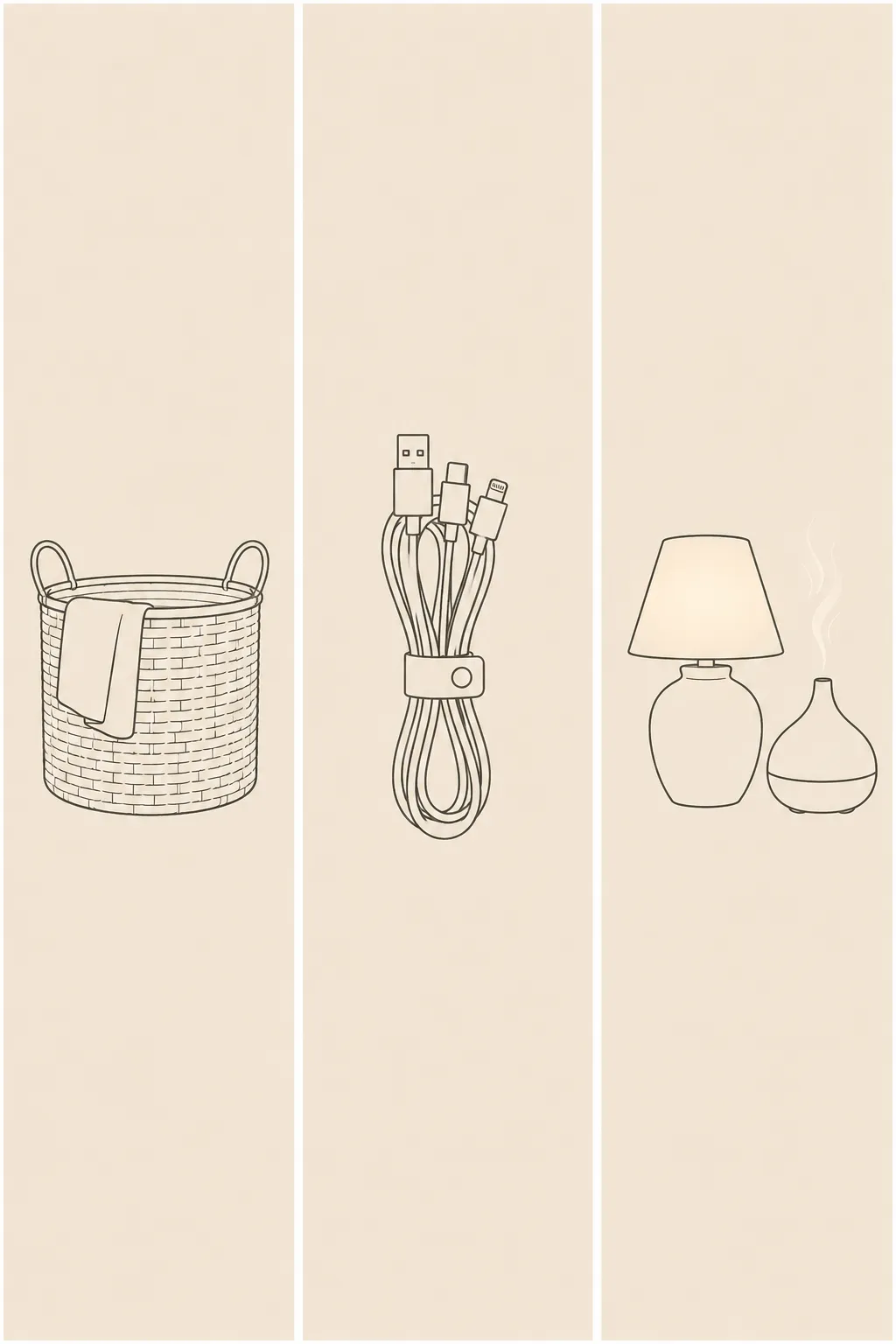
The first five minutes target the most prominent horizontal planes in the room: the coffee table, kitchen counter, and nightstand. When these surfaces are covered in scattered objects, the entire apartment feels immediately heavier.
Many organization researchers, including the well-known drop-zone strategies popularized by Alejandra Costello, suggest using a temporary “holding basket”. Instead of finding the perfect home for every stray receipt, charger, or piece of mail, gather them into a single, opaque woven basket with a lid.
This single action immediately drops the visual noise level. It provides the eyes with a clear place to rest without requiring the cognitive effort of a full cleanup.
Minute 5-10: The Cord & Cable Blackout
Once the flat surfaces are clear, the focus shifts to a modern source of underlying friction: technical clutter. Dangling wires, exposed extension cords, and intersecting chargers create sharp, chaotic lines that disrupt the visual flow of a room.
Insights on environmental psychology from the Rocky Mountain College of Art + Design in their guide, Psychology of Clutter, highlight that visible cables and technological disorganization overload cognitive processing, signaling an “unfinished” task to the brain that fuels underlying stress.
Taking five minutes to tuck chargers out of sight, or bundling television wires using simple velcro ties, eliminates these micro-anxieties. This small adjustment makes the perimeter of the apartment feel instantly sharper and more intentional.
Minute 10-15: The Sensory Shift (Lighting & Scent)
The final stage shifts the environment from active to restful. Many renters unknowingly keep their brains in a state of high alert by relying on bright, overhead lighting that mimics a corporate office environment.
Research shared by Meik Wiking, CEO of the Happiness Research Institute, in his book The Little Book of Hygge highlights the critical role of lighting in winding down the nervous system.
Turning off harsh overhead bulbs and switching to low-level point lighting—like warm floor or table lamps around 2700K—signals to the body that the workday is over. Introducing a familiar, calming scent like sandalwood helps solidify this sensory transition.
Once you complete this 15-minute physical reset, turning it into a consistent habit requires a psychological boundary. Explore The "Closing Shift" Routine: How to Put a Small Apartment to Sleep for Mental Relief to learn how combining lighting transitions with macro-sorting effectively signals your nervous system to power down.
Maintaining Low-Friction Living in a Renter-Friendly Space
While a quick reset offers immediate relief, long-term peace of mind relies on building a low friction apartment setup. According to the environmental design principles discussed by habit researchers like James Clear, the easiest way to maintain a good habit is to reduce the friction required to execute it.
For intentional living in small spaces, this means relying heavily on closed storage systems. Renters often find success by swapping open shelving for simple, modular closed units—such as an IKEA BESTÅ or Kallax fitted with solid doors.
To transform these modular units into a seamless visual shield that hides everyday clutter, explore Invisible Storage: 7 Low-Visual-Noise Systems That Make Tiny Apartments Feel Instantly Calmer to discover renter-friendly hidden storage ideas and IKEA modifications designed for zero-friction living.
Relying on these renter-friendly storage ideas to hide clutter provides a physical shield. By placing everyday chaos behind a closed door, maintaining the “visual silence” of your apartment becomes an automatic default rather than a daily chore.
Sources & References
- The Restorative Benefits of Nature: Toward an Integrative Framework — Stephen Kaplan | Journal of Environmental Psychology (ScienceDirect)
- Interactions of Top-Down and Bottom-Up Mechanisms in Human Visual Cortex — S. McMains & S. Kastner | The Journal of Neuroscience
- The Interior Design Handbook: Furnish, Decorate, and Style Your Space — Frida Ramstedt | Penguin Random House
- The Life-Changing Magic of Tidying Up: The Japanese Art of Decluttering and Organizing — Marie Kondo | Ten Speed Press / Penguin Random House
- Minimalista: Your Step-by-Step Guide to a Better Home, Wardrobe, and Life — Shira Gill | Ten Speed Press / Penguin Random House
- Remodelista: The Organized Home: Simple, Stylish Storage Ideas for All Over the House — Julie Carlson & Margot Guralnick | Artisan / Hachette Book Group
- The Kinfolk Home: Interiors for Slow Living — Nathan Williams | Artisan / Hachette Book Group
- Psychology of Clutter: Designing Organized and Stress-Free Spaces — Rocky Mountain College of Art + Design (RMCAD)
- The Little Book of Hygge: Danish Secrets to Happy Living (The Happiness Institute Series) — Meik Wiking | William Morrow / HarperCollins